Showing posts with label review. Show all posts

Friday, July 30, 2010

Inception (Review/Essay)

Warning: This post contains spoilers for multiple movies.


I've put off writing this review because I think this movie is causing a lot of knee-jerk reactions. Whether from Nolan disciples who have been slavering for it for a year and a half loving every second, or people on the other side of the aisle who either genuinely hate the director or are just being anti-populist. Personally, when the movie was announced, my reaction was "wow, what a cast, but I'm not all that fussed." Then the trailer came out and my reaction was "wow, what a cast, but I'm not all that fussed." Then I saw the movie and my reaction was "wow, what a cast, but I'm not all that fussed." After letting it stew and thinking about it for a few days, that opinion hasn't changed. I'm not rushing out to see it again, nor will I, nor am I picketing the movie theater because I hate it so much. I have good things to say about the movie, and negative things, and I present them here.

Wednesday, February 17, 2010

The Imaginarium of Doctor Parnassus (Review)


Some movies need but an open mind and open arms to achieve something memorable. While The Imaginarium of Doctor Parnassus is a flighty and, at times, lost example of one, it is indeed one of those films.


Crafted by co-writer/director Terry Gilliam, whose noticeably French-influenced style of filmmaking makes him particularly interesting to keep track of, Parnassus will keep you as confused and insecure as its subject matter: a traveling sideshow headed by the immortal Dr. Parnassus (Christopher Plummer).


The only thing consistent about the film is its inconsistency, caused perhaps by the death of its lead (Heath Ledger, as the sideshow's newcomer, Tony) mid-shoot, which resulted in a complete retooling and the casting of Johnny Depp, Jude Law and Colin Farrell as Tony's other selves; but to shrug off what becomes the film's critical feature—an askew universe that ties both the characters and viewers into knots—as a mere happenstance would be a nearsighted and lacking departure.


When In Rome (Review)

Recipe for When in Rome: Take 1 bland, expressionless leading lady, 1 male counterpart so average it hurts, a handful of trite, obnoxious supporting characters, mix them all together in a bowl of exploitative, sexist, depressing, repressing and suppressing ideology, and send it to hell to bake for 91 minutes. Congratulations director Mark Steven Johnson, it came out perfectly!


More disgusting and disturbing a film than any torture-porn out there, When in Rome is a vile retreat into gender stereotypes and male worship, a film that stitches together every one-dimensional character, every flat, overplayed joke, and every pig-headed idea of love that the movies have ever provided us into something truly terrible.


Beth (Kristen Bell) is a working girl who just can't seem to get love right. In Rome for her sister's wedding, Beth steals a variety of coins from a magical fountain in spite of romance and happy-endings, unknowingly cursing those whose coins were picked to fall in love with her.


Wednesday, January 27, 2010

Legion (Review)

Film is a reliable place to look when seeking out our own weaknesses. The Day the Earth Stood Still (1951, not 2008) assures us it’s our own trigger-happy nature that will do us in. WALL-E has the human race complacent and consuming, our globe rendered one giant dust bowl. Al Gore is practically banking on the ice caps melting.


Humankind loves to predict our own end. And, whether it's by nuclear annihilation, global climate change or good old-fashioned sinning, we love it the most when it's our own fault.


Wednesday, January 20, 2010

The Lovely Bones (Review)


The Lovely Bones is not a movie; at least not in the sense you and I think of one. It has no coherence, no idea of what it's doing, what its purpose is. It barely has a plot. I'm still not sure if it has any scenes, whatsoever.


What The Lovely Bones does offer, however, is a tangled marsh of unfocused emotion, unclear characters and uninspired dreamscapes, all of which sum up to make a moving picture, yes, but a movie? No.


Monday, November 23, 2009

The Box (Review)

The year is 1976, an innocent age in which an unmarked package is nothing to worry about, and half of Frank Langella walks around being mysterious. It's a time when conspiracy lurks around every corner, when no one can be trusted; it's the time a terrible movie occupies. It's The Box.


Adapted from a short story by Richard Matheson (I Am Legend), The Box is a science fiction, fantasy, mystery, thriller, conspiracy, romance, horror film with so many plot points and references that it caves in on itself, revealing in its wake the dusty remains of Cameron Diaz trying to act sincere.


When couple Norma and Arthur Lewis (Cameron Diaz and James Marsden) are visited by the deformed Arlington Steward (Frank Langella) who offers them cold hard cash in return for the couple's cooperation in killing an unknown person, a series of off-the-wall events involving hypnotic, somnabulant peeping-Toms, government cover-ups and other-worldly magical nonsense are set off.


Michael Jackson's This Is It (Review)


It's not enough to say Michael Jackson was eccentric. Michael Jackson, at least in his later years, was a caricature of himself, a part he perpetuates even in death in Michael Jackson's This Is It.


This Is It was previously going to be Jackson's final tour, a production that would match Jackson's life in size and scope, sparing no expense in creating a memorable farewell to music for the man that practically invented it. After Jackson's untimely death, however, the superstar's concert co-director, Kenny Ortega, was left with a massive pool of unused talent and effort and hours of stock rehearsal interviews and footage. Thus was born This Is It, a documentary meets musical that is more a tribute film than anything else.


Ortega is a middle-aged Jackson fan-boy who kisses the ground MJ walks on throughout the film. In many scenes, Ortega gushes over the musical icon while treating him like a child at the same time, an attitude that is oddly fitting when dealing with the Peter Pan wannabe.


Wednesday, October 28, 2009

Paranormal Activity (Review)


With a tense, grinding build-up that lasts the majority of the film, Paranormal Activity shows a patience that few thrillers can manage to compete with. The jump-starting fright phenomenon is slow to begin, but when the lights start to illuminate the theatre, there's no denying that this film will keep you up at night.


The film follows young couple Katie and Micah as they attempt to capture on tape evidence of the paranormal presence that has supposedly followed Katie throughout her life. Produced for around $15,000, the entire film is shot through Micah's portable camera he goes nowhere without.


Paranormal Activity is a combination of The Blair Witch Project (1999) and Kiyoshi Kurosawa's Kairo (2001), mixing a low-budget, documentary style with the chills of ghosts, demons and poltergeist. The film's realism is what drives it, as those who are blind going into the film question throughout: Did this actually happen?


Paranormal Activity, unlike many of its horror/thriller rivals of the day, is more concerned with quality than quantity. Katie and Micah are full, three-dimensional characters whose personalities effect the plot instead of vice versa. Who they are and how they manage as a couple effects how they deal with being terrorized by the thing they can't explain.


Much like Blair Witch, Paranormal Activity makes the camera its own character. As its being hauled around, peaked around corners and subject to what the couple does not see while they sleep, the audience begins to feel like the kid that's forced to go first into the haunted house. In this way, viewers actually play a role through the eye of the camera, making the film that much more real and that much more terrifying.


The quality is also in the pacing: the film stacks up the tension bit by bit, letting the audience relax on occasion between night scenes, but is relentlessly warning of the further terror to come. When the couple isn't dealing directly with demonic possession, they are slowing piecing together information and discussing their next move, a progression that only further adds to the suspense.


The only problem with this structure is its repetitiveness. The audience is in constant wait of a climax, which bodes well for a thrilling ride, but frustrates when that climax doesn't come when expected. This becomes a distraction late in the film as viewers lie in wait for something “big” to happen, constantly questioning when the movie will pick up.


It's refreshing to see a horror movie return to its genre's roots, focusing on what's “horrific” about how humans view the world rather than what in the world scares us. How Micah sees his role as a human being in relation to what exists around him becomes the truly terrifying subject of the film. The fact that we are not always in control—of our loved ones, of ourselves and of the other beings of this world—is what scares us the most in Paranormal Activity.


Nary a cheesy or laughable moment exists throughout the couple's experience, as queues from shows such as “Most Haunted” and “Ghost Hunters” are seemingly replicated in depicting a truly eerie demonic presence. The sounds of the house prove to be one of the scariest elements of the film—the repeated thud of footsteps on the stairwell becomes a trademark of the evil in pursuit of Katie. Even the always-present whir of the camera—what might be called the film's only soundtrack—is enough to push viewers down into their seats.


The ending, which supposedly was altered upon Steven Spielberg's suggestion, in my opinion, could have been done differently, but still serves justice to the overall picture. The lack of credits is another way Paranormal Activity feeds the realism, a trick first time writer-director Oren Peli was smart to use.


With a calculated, intelligent script and an uncanny knack for realism, Paranormal Activity is the best scare cinema has had to offer in a long time. The film's unbelievably low production cost coupled with its break-neck shooting time (reportedly 7 days) proves that good movies rely on the fundamentals of film making, not the size of its star's salary.


Thursday, October 22, 2009

Couples Retreat (Review)


While Couples Retreat shows a genuine effort to be a funny movie that tackles serious issues about marriage and relationships, the end result is an ultimately familiar and flaccid, albeit amusing, attempt at meaningful comedy.


Couples Retreat stars Vince Vaughn as the same character he has been playing for 10 years. Dave is abrasive and overbearing, dealing out the fast-talking one-liners like carrots at a fat camp, but only in an effort to mask his heart of gold.


Dave and a group of his friends, four couples in all, go on a trip to Eden, an island getaway intended for couples that need to rekindle their love. When they arrive they realize that the “couples skillbuilding,” what only one couple, Cynthia (Kristen Bell) and Jason (Jason Bateman), has come to experience, is required for all. Wackiness ensues.


Each couple is representative of one form of a relationship: one that isn't ready and won't work, one that has dried up and lacks togetherness, one that has forgotten faithfulness and communication and one that is over-regulated and out of sync. However convenient it is to see each form laid out clearly for all to see, by stereotyping relationships the film contradicts its own meaning.


By systematically categorizing the problems couples face, the film upends the theory it promotes throughout: each couple is individual by nature, and must deal with their problems in different ways. The couples of the film, despite their accuracy in resembling some real-world relationships, are flat; they lack the nuance we relate with deep relationships, thus making it hard to truly attach oneself to the characters.


The acting is what one would anticipate from the troupe of comedy regulars, yet the material given to them allowed little to work with. Even the charm of Jason Bateman, who has been in every film made since 2006 (how does he find the time to be in so many movies?!), cannot spice up this film's average flavor.


Vaughn, who co-wrote the film with Jon Favreau and Dana Fox, brands the film with his unmistakable style of comedy. Much like a conversation with a relative, the film incites viewers to simply smile and nod until its over. Some lines prove giggle-worthy, but beyond that expect sex jokes that fall flat by the truckload.


Obviously judging from the aforementioned criticisms, Couples Retreat is not a great film, but that doesn't necessarily mean it's terrible. It's average, mundane, run-of-the-mill—it's the Burger King of movies. Yes, you'd rather have MacDonald's, but at least it's something.


Couples Retreat is too easy. It's a cop-out. The shallow characters and basic story structure is fine for something one could turn on and fall asleep to on a Saturday afternoon (the definition of a Vince Vaughn movie), but it will not be the crown jewel of your collection when it comes out on DVD.


The Invention of Lying (Review)


It's no surprise that Ricky Gervais would come out with a movie about lying. The English comic, who brought us shows such as “The Office” and “Extras,” has made a career out of showing us the awkward underbelly of society in its efforts to hide, distort and wish away the truth.


The Invention of Lying plays with the same idea, but in expected Gervais fashion, the film grounds itself in a sentimentality that challenges viewers to question how we judge the world and what we deem to be and not to be.


Where the potential for comedy thrives in the idea of one liar in a world of truth, the social setting is not one primed for side-splitting antics.


The film is set on an earth where lying does not exist. In fact, fabrication of any sort is out of the picture, and society's only concerns are with what it defines as the truth. Fat people, people without jobs, poor people—they're all seen as “losers” (a term that comes up many times throughout the film) who have little potential to succeed and therefore become invisible to those who are rich, attractive, powerful or talented.


Twenty minutes into the film, it is clear that the world of the “truth” is quite depressing. This is not just for the fact that what people say to each other is harsh and blunt (what makes up for most of the comedy of the film), but it's that everything coming out of people's mouths is a negative—a put down, a sad piece of their lives, a pessimistic, self-hating mantra that works to bring down the audience instead of make us laugh.


Society's inability to fabricate seems coupled with their inability to care. That's not to say that merely niceties and forced complements are absent: care in any form is hard to come by.


In one scene, Mark Bellison (Gervais) visits his mom after being insulted and rejected by his previous night's date and tells her he suspects that he may lose his job. He expresses how he has little hope for the future, that he has no money, no prospects and little to look forward to, and she shrugs him off.


“Things could be worse,” she says. “We could be homeless.”


This of course is followed by Bellison getting evicted, which pushes him to the end of his wits.


About midway through the film, after Bellison discovers lying, the narrative takes an odd turn and begins to give its own take on Christianity and the Ten Commandments when Bellison tells the world of how there is a “man in the sky” who dictates what happens to people when they die.


In dangerous criticism of Christianity and religion in general, The Invention of Lying depicts a society that relies too heavily on what others think and say and believe, and relates how that attitude reflects our own culture's misuse of what started as a mere story, a fabrication, of what governs our existence.


In a telling scene near the end of the film, Bellsion is accosted from behind and, upon requesting an admittance of fault, is met with further disrespect and rejection of compassion. Despite the fact that this society knows now to be good and kind and understanding, its view of the world has not changed in the least.


This allegorical backdrop is the film's most interesting aspect, as the cheeky, improv-style comedy and awkward romance fail to deliver. It's disappointing to see Gervais, who shared writing and directing credit with Matthew Robinson, not live up to what we're all used to even surrounded by a star-studded cast with cameos by Jason Bateman (Extract), John Hodgman (“The Daily Show”), Tina Fey (“30 Rock”), Edward Norton (everything) and Christopher Guest (This Is Spinal Tap).


The Invention of Lying is the result of a good idea warped and faded, with its situational comedy too dreary to be funny, but not enough so to come out the other end as a more dramatic, yet entertaining, creation.


Pandorum (Review)

Pandorum, directed by Christian Alvart, is the latest telling of a sci-fi soap-opera. Two sole men wake up aboard an enormous spacecraft with no recollection of their mission, and even littler knowledge as to where the rest of the crew went. As it plays out, Pandorum feels more like a video game than a film, as it provides exhilarating action sequences and skilled camera work, but lacks on character development and dialogue.


The film starts with a timeline of humankind's landmarks in space exploration with the corresponding population of the earth. The last date is 2174, the year our protagonists' ship is sent out into space; earth's population is more than 20 billion.


In this early scene, space is humankind's refuge, our chance to start anew. Space, despite its ominous presence, is a lifeline. Throughout the rest of the film, Alvart and screenwriter Travis Milloy upend this ideology, proving to a horrific measure how unforgiving space can be and how much we should cherish the place we are.
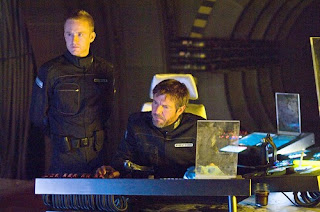


Pandorum exhibits a plethora of innate human fears, each of which space and the spacecraft, which serves as the film's only physical setting for nearly the entirety, prey upon throughout the film.


Viewers are tossed quickly into the nightmarish fray, as Bower (Ben Foster), our protagonist, violently wakes out of cryo-sleep half-covered in ice. He screams wildly in vein as the camera pulls away from his frozen pod to reveal only darkness.


This is an early example of Alvart's ability to relay a feeling of terror; he does not back us into the experience, he plunges in.


A key component to horror film making is setting a tone, and Pandorum does this well. The combination of freezing temperatures, still darkness and silence warn audiences of one thing: lifelessness.


Viewers are not called upon to simply watch these opening events take place, but we are forced to live them. The camera's sporadic movement inside the pod as Bower struggles to escape lends to a sense of panic, a subjectivity that will remain throughout the film.


Soon Bower is released and helps one more crew member, Payton (Dennis Quaid), Bower's commanding officer, wake up. The rest of the film follows Bower as he journeys through the ship in search of the engine room, where the ship's reactor must be manually reset in order to avoid certain death.


Along with isolation, Alvart introduces claustrophobia in an early scene in which Bower crawls through the ship's vents. This incremental introduction of challenges and terrors is simple, but effective.


As the vent becomes tighter and tighter, darker and darker, Bower begins to panic once more. His claustrophobia becomes the audience's, as the camera is pushed in on by piping and darkness.


With only the threat of a cold room and a tight squeeze, these two opening sequences illustrate how simple it is to instill a sense of horror through film making; this opening is a refreshing reminder that film can create horror as long an ideology of fear is present.


The rest of the film, I'm disappointed to say, does not continue along the same path as it starts. Following the two opening sequences, much of the horror comes from freakish, humanoid monsters that hunt Bower.


Adding monsters to an already frightening experience only dulls the suspense the film works to achieve in the first place. As Bower and company run away from and do battle with the beasties, it felt strange to not be holding a controller in my hand.


One particular scene near the end of the film is laughable in how close it resembles a video game in pacing and composition.


Developed as the leader of the monsters, the strongest creature corners one of Bower's friends who finds himself unarmed. In the classic “boss battle” format, the two square off head-to-head from opposite sides of the shot (think Mortal Kombat) ... but not before the monster throws his foe a weapon, as a true gentleman should.


The overall story arc is underdeveloped and poorly delivered, but remains to hold on to viewers' attentions to the very end—an end that is halfway unique and halfway predictable, but, oddly, wholly satisfying.


Pandorum will not be the sleeper hit of the year that it very well could have been, given a less central reliance on cliché sci-fi monsters and more character background and development. However, for those seeking cheap thrills with an attempted backbone, you can't go wrong.

I Hope They Serve Beer In Hell (Review)

The introduction to Tucker Max's web site states, “My name is Tucker Max, and I am an asshole.” I couldn't have said it better myself.


I Hope They Serve Beer In Hell is an adaptation of Tucker Max's book by the same title, which showcases Max's unbridled recklessness in the face of all that is decent and good. The blogger phenom spends his time drinking, having sex and mixing the two together to come up with the most unbelievable (but supposedly true) stories any shallow, college-aged boy—that's right, “boy”—would envy not being a part of ... and now he's made a movie.


The film follows three friends, Dan, Drew and Tucker Max as they set out to have the craziest bachelor party possible a la The Hangover, but where the latter succeeded in its uncharacteristic plot structure and uproariously funny dialogue, Hell force-feeds viewers cheap, quippy jokes in its portrayal of who must be the saddest men on Earth.


Featuring non-stop beer, a Halo-centered plot device and enough naked women to rival Hugh Hefner's roster of girlfriends, Hell plays like a 13-year-old's wet dream—needless to say it doesn't appeal to anyone seeking any sort of depth beyond a feigned attempt at character development.


As the film drags on, it becomes apparent that Max is a self-driven meathead who is willing to abandon and recklessly disregard the well-being of his friends in the search of a good story. However, as the film parades as an attack on the bigoted, chauvinistic tendencies of modern young, white men represented by Max, it bolsters just the opposite in doing so.


No real consequences come in response to Max and company's actions, which, telling in the film's true motives (be they conscious or not), are glorified throughout.


Tucker Max, who co-wrote the film with Nils Parker, definitely has a knack for storytelling ... but this doesn't mean it's a good story. What I'm guessing started as a truly entertaining tale told to a gang of university beer pong experts does not translate well to the big screen. In a world where absolutely anything can happen, drinking and strippers fail to amaze.


The film's production qualities are some of the lowest of any wide-release movies of late. The acting, aside from unknown Matt Czuchry (Tucker Max), ranges from bad to sickly, as it seems many of the characters were played by the rejects of the most recent high school production of “Jesus Christ Superstar.”


The dialogue is equally atrocious. What might have read as clever and sharp, sounds overworked, unrealistic and, despite consisting primarily of vulgarity and “yo momma”-esque comebacks, pretentious. Think Juno on crack.


Hell, like many films created with the college crowd in mind, has every right to tout its high level offensiveness, but in no way does the number of people a movie can turn off constitute a success of any degree. Usually offensive material suggests an underlying theme, a carefully interwoven social allegory, commentary on the state in which we live—Max's film contains none. Hell is a pointless, circular, self-congratulating mess, as shallow and dry as the lonely, sex-addicted man it revolves around.


I Hope They Serve Beer In Hell is the opposite of what a comedy should be. It's shameful anecdotes on drinking and women, the abuse of which Max observes as males' “destiny as men,” are advocated for under the guise of satire, making the film feel more like a white-power rally than anything else. O, and in answer to the title, no: they didn't serve any at the theatre.


Saturday, September 19, 2009

9 (Review)


Back in 2005, Shane Acker created an 11 minute short called “9.” Now four years later, Acker is back and he brought some Hollywood friends along this time. Produced by Tim Burton, 9 takes an otherwise blasé and mundane story about a fore-coming apocalypse produced by Machine v. Man warfare and dresses it up in CGI clothing.


Instead of following a band of last remaining humans, the film puts a rag-tag group of...rag dolls at the center of the narrative, following a repetitive formula the whole way through. 1) A machine threat is produced. 2) Our heroes defeat the threat. 3) They talk. Rinse and repeat.


The charm of the silent original has faded away leaving behind a husk of its former self, stuffed to its ears in production values unable to stand on their own.


Many of the film's artistic choices are entirely too reminiscent of other films. The machines look as if they were cut directly from The Matrix and spliced in with a CGI retool. Some shots are shockingly resemblant of The Lord of the Rings trilogy, especially one particular crane shot that features two main characters in the forefront and a set of ominous towers in deep focus.


The anti-technology sentiments may well have been ripped right out of The Terminator and I, Robot. Technology is bad, especially in the hands of bad people; audiences have been spoon-fed this message since the term “sci-fi” was first coined.


Those complaints aside, aesthetically, 9 is attractive and pleasing. Acker's designs are superb; the different self-made monsters that the machines build leave the viewer curious as to what will come next. These ingenious designs—taking after various intimidating animals—save the film from drowning in its formulaic narrative.


Overall, 9 felt confused with what kind of movie it wanted to be: intense, sci-fi horror, or family-friendly cartoon. While most scenes are suspenseful and compositionally disheartening, the ending is much more Disney than the original short (and less satisfying).


9 is a huge disappointment. What could have been an interesting and dark stand-out picture was torn in two between the box office and artistic integrity. The only remaining qualities of its former rendition—a haunting soundtrack and unique character design—luckily saves it from the Dreamworks graveyard of CGI film.


All About Steve (review)

It's hard to imagine what goes through the minds of those who make movies like All About Steve. Drowning in cliché social criticisms, the film plays like we've seen it a hundred times before, failing to generate any inkling of sympathy for the characters involved while desperately attempting to reel in all possible fans with its version of Apatow-esque comedy.


All About Steve tells the story of Mary Horowitz (Sandra Bullock), a quirky and talkative crossword puzzle creator, who follows a news cameraman, Steve (Bradley Cooper), around the country after he inadvertently invites her along during a less-than-successful blind date. After experiencing multiple newsworthy events, viewers are taken to a final location where Mary becomes the center of the news frenzy.


All About Steve is more like a fairytale than a realistic portrayal of life and relationships. The film tries to delegate a childlike message of “be true to yourself,” but takes it to an extreme with stereotypes and a black-and-white outlook that ends up with a downright disturbing lesson: weirdos and “normal” society do not belong as one.


This theme is supported throughout the entire film as Mary tries to inject herself into normality, but fails to do so in every attempt. Although the ending is a very predictable amalgamation of good feelings, it still very much fosters the attitude of segregation that the rest of the film exhibits throughout.


Mary as a character is a socially inept know-it-all who is obsessed with words and the use thereof. An out of place voice-over narration sprinkled throughout the film (a common technique utilized by scriptwriters who don't know how to get their message across by ways of more skillful means such as character interaction and dialogue) features Mary babbling about words and their meanings and how it relates to her life.


This technique trades subtlety for blatancy, literally telling the audience exactly what they should be thinking about and the connection between vocabulary and Mary's life philosophy. This aggravation is both belittling and boring, as it assumes the audience isn't capable of figuring out the intricacies of Mary's character on their own.


The humor of All About Steve is typical and blasé for the most part, but I did find myself smiling on occasion. Steve and his two companions, Hartman (Thomas Haden Church) and Angus (Ken Jeong), make up a fairly entertaining trio as they bicker around the nation in a news van.


After giving it some thought, I am completely stumped as to why films like All About Steve exist. It was never going to be a giant blockbuster, nor an Academy Award winner, nor an art-house cult classic. It seems All About Steve was destined to be a forgettable, stereotypical venture into relationships and self-discovery unable to win over audiences already accustomed to more intelligent and poignant 2009 romantic comedies such as (500) Days of Summer and Away We Go.


Friday, September 4, 2009

Halloween II (Review)

One of the first of a wave of remakes meant to re-energize and re-establish otherwise played and creatively starved series, Rob Zombie's 2007 Halloween was a good effort, but made a lot of the same mistakes that continue to plague the slasher genre. Now two years later, Zombie returns with Halloween II, proving that Michael Myers should have died a long, long time ago.


The refreshing distinctions that saved the 2007 film from failing completely, such as a thorough look into the childhood of Myers, which remained untouched since the pop-culture icon first started slicing up teenagers back in 1978, are completely absent from its sequel. The film starts off directly where the last one ended—and this is Zombie's first mistake. Halloween II adopts the poorly constructed plot and laughable dialogue that made the second half of the 2007 remake so disappointing. With little briefing, we are placed in the hospital with protagonist Laurie Strode, who shot Myers in the head at the end of the last film. Unbeknownst to Strode, Michael Myers has survived (who would have guessed?) and has infiltrated the hospital looking to finish Strode off, thus beginning another 2 hours of running and hiding.


With a weak central plot, Halloween II relies on the random victims of Myers to provide the meat of the story (no pun intended). Zombie adds scenes of unimportant and unrelated killings in an obvious effort to supplement a tattered main narrative. As if it hasn't been established enough already, Zombie emphasizes Myers' ability to easily take down those who oppose him on numerous occasions. Myers kills six people in two separate scenes who are completely unrelated to the story, providing unsatisfying “fluff” that does the opposite of what it's designed to do and incites boredom instead of suspense.


A “disturbing” series of dream sequences are littered throughout the film, bringing back Myers' mother from the last movie (played by Zombie's wife, Sheri) in an effort to add a sort of spiritualism to the film. Aesthetically reminiscent of The Unborn (2009), the sequences suggest (in a highly underdone way) that all the Myers share some sort of spiritual wholeness, thus inevitably connecting Strode, Michael's long-lost sister, to the killer. If done correctly, this emphasis may have been slightly interesting, but instead it comes off more like a plug for Sheri Zombie's acting career.


Halloween II also brings back Samuel Loomis (Malcolm McDowell), Myers' lifetime psychiatrist who spends the movie traveling to different venues promoting his new book based on the life and times of Michael Myers. This final side story is the most unfocused of them all. In it, Zombie criticizes those who prey on the misfortune of others—the media sharks and publicity-seekers that use tragic events for their own profit. Although clear, the message comes as a footnote to the picture as a whole, merely providing another distraction from the lacking plot.


Following the lead of many modern-day directors who try to cram too many storylines, ideas and themes into their films, Zombie becomes bogged down with his own ambitions and ends up with multiple unsatisfying, unfinished and underdeveloped narratives in one movie. Instead of achieving a cohesive and effective message, Halloween II leaves the viewer with confusion and bewilderment. Why did he kill that guy? Was he in the first one? Where is the killer? Why are we watching this?


Despite the film's inability to deliver a meaningful and enjoyable experience on the whole, I don't want to completely discourage Zombie. He obviously has cinematic vision, adding some interesting stylistic compositions and artistically creative sequences to the film. In one scene, a blurring effect is added as Myers takes a victim in slow motion. The actual murder is presumed and not shoved in our faces like usual, which was both refreshing and eerily effective. Later in the film, Zombie pulls the camera back to watch Strode flee in the moonlight which overexposes the lens in a visually pleasing composition. These examples of creativity save the film from becoming an utter loss.


The slasher genre is a slowly fading trend. What was once a new and exciting statement about violence and fear is now a played shadow of its former self. Where others such as Batman Begins and The Dark Knight succeeded, the Halloween remakes fail to revitalize a fading legacy and are a clear example of how none of us, no matter how hard we try, can breath life into something that was never alive to begin with. Let's hope Michael Myers goes the way of the slasher and dies off, once and for all.

Friday, August 14, 2009

District 9 (review)

WARNING: May contain spoilers.


Science fiction either works or it doesn't. It can either change the way movie-goers think of cinema and the world around them or it can fall completely flat. The genre walks a very thin line, with one side being completely unbelievable and sometimes laughable and the other masking its nonexistent story with wall-to-wall action in an attempt to make bank at the summer box office. Luckily for us, District 9 is a tight-rope walker extraordinaire. Achieving the perfect balance of action and suspense, District 9 is one of the best sci-fi films I've seen in years. Directed by Neill Blomkamp, District 9 proves that good summer movies still exist and that filmmakers don't have to throw out smart dialogue and a deep, thematic plot in order to deliver spectacular action and visuals.


Following Wikus Van De Merwe, tasked with relocating over 1 million aliens out of Johannesburg where they arrived some 30 years ago, the film takes viewers somewhere very unexpected, greatly differing from the cliche human-meets-alien plot-line. Surprisingly, the film bypasses the usual "what are these things?" introduction and cuts straight to 30 years later, when humans and aliens must find a way to coexist. Behind the mask of some of sci-fi's most recognizable subjects (aliens vs. humans, grotesque deformations, high-tech machinery, etc.) lies a deep, thematic character commentary highlighting some of mankind's most infamous qualities: racism, greed, and the unquenchable desire for power. Wikus tackles these demons head-on throughout the film as he is quite literally put into the skin of the thing he knows the least about and thus fears the most: an alien species.


It was not by accident that this film takes place in South Africa. Just as Nate mentioned below, the film seems to be reminiscing about a nation torn in two by apartheid. Much of the film takes place within District 9, a militarized slum where the aliens have been forced to live since their arrival. Filled with pieced together sheds amongst heaps of garbage, District 9 is massive evidence of the oppression forced upon the aliens. Of course racist ideals fuel the human populace's toleration of such miserable living conditions. This deep-seeded racism is the general theme of the film as Wikus must deal with his own view of the aliens which continual changes as the plot advances.


Wikus Van De Merwe is a seemingly oblivious character to begin with, baring a striking resemblance to Murray from “Flight of the Concords” in both look and speech. Despite being somewhat of an “expert” when it comes to the alien species, Wikus has the longest to go in reversing his racist tendencies and thus proves to be the perfect character to follow. His “playful” racism, however, is juxtaposed with the supporting characters' “murderous” racism and a clear distinction between good and evil is made.


The imagery of District 9 is simply haunting. Think City of God meets Signs. To think that people actually do live like the aliens in their slums is enough to make you lose sleep. The aliens look perfect, despite the few minutes it takes to get used to them; not once was I forced back into the reality of the theatre to think “that's fake.” The nonstop violence of the second half rarely gives the viewer time to take a breath. Despite the few comedic moments designed to break the ice, District 9 is an intense film that does not get bogged down with making the viewer feel safe. Each piece of the narrative, from Wikus' efforts to redeem himself to the aliens' attempt to return home and the forces that be fighting against them both, ties together in one neat package with no thrown in side stories that go nowhere or useless characters that just get in the way. Blomkamp does a great job keeping the plot focused and every character doing exactly what they should be doing.


Overall District 9 is an amazing achievement that greatly exceeded any expectations I had going into it. Thus far it is easily one of the top five movies of the year and probably the most entertaining and masterful sci-fi movies I've seen in quite a long time.

Ponyo (Review)


Well I've seen it. I'll preface my review by saying I will go again. Twice. Opening day. Once it finally comes here. Australia gets it August 27th so I hope against hope I'll get it sometime around then (no word yet).

I live for Miyazaki. Ever since I saw either Totoro or Mononoke (can't remember which was first), it's been my purpose in life. To watch his movies. Spirited Away cemented my love. It's the best movie of all time. So basically I've been looking forward to Ponyo since 2002 or 2003. So it's also safe to say my expectations were gargantuan. Even pretty devout movie freaks wouldn't understand how high they were. The only thing that would compare would be a super-religious person's expectations of Heaven. And (you probably expected this), those expectations were utterly crushed.

What I (and you) have seen in the trailers is all from the first half. Really they showed nothing. Happy about that. The story is pretty damn simple. Ponyo is a curious goldfish who meets a five-year-old boy (Sosuke) and wants to become human. Sosuke is the son of a fishing boat captain and a senior center aide. He's an intelligent boy who knows Morse code (so he can talk to his dad on the ship from his cliff top house), can pilot a small boat, swim with great confidence, and be a good friend to an entire town. Lots of Miyazaki's main characters are like this (Nausicaä and Patzu come to mind instantly), but Sosuke feels more real. Yes his world is still fantastical, but he's just a normal little boy.


This is Miyazaki's "youngest" effort since Totoro, and Ponyo rivals it in target audience age. It's a kid's movie. And there is no one on the planet who can make movies that can universally connect with children, from anywhere, and of any age. I can't imagine any kid wouldn't be enthralled. The kids are so relatable and good you just root for them. You want them to succeed. You feel sad when they do, and happy when they do. There is conflict but no one's ever in any real danger. Well, maybe they are, but their confidence gives you confidence as well. As per tradition there really is no "bad guy", Miyazaki villains (excluding Muska from Castle in the Sky) tend more to be "conflict instigators" who create conflict but with no real bad intentions. That's especially true here. Fujimoto doesn't want to give up his daughter, he's as much a bad guy as King Triton is in Little Mermaid.

This was the first Miyazaki I've seen in Japanese. I think with this it made no difference as there actually wasn't all that much dialogue. The subtitles I think will be almost exactly what the English dialogue will be. There was very little to change so there weren't many made (Japanese-speaking friend of friend said they were pretty close). I'm very interested in the English cut now though. Big stars with very very few lines, Matt Damon's character in particular, will be interesting. Most of the dialogue is spoken Sosuke (little Jonas), his mom (Tina Fey) and Fujimoto (Liam Neeson), and I'm sure they'll all be able to pull off their roles (how hard can it be for a little boy to voice a little boy?).

I'll be the first person to tell you Pixar is the best American studio making films today. They are. There's no question or competition there. But when it comes to best in the world, it's a different story. No person or studio that is, has been, or will be can even hold a candle to Miyazaki and his artists. Ponyo is a work of art from first to last frame, each and every one meticulously hand crafted by the best animators in the world. Water color was definitely the way to go for a water-based film like this. The colors are rich and vibrant and they sparkle on-screen. Whether it's Sosuke's house or a group of trees or an underwater seascape the drawings seem to breathe even if nothing living is in them. The characters, be they human, fish (real or not), or god are perfectly at home in this village that resembles a present-day version of the coastal town in Howl's Moving Castle.


Joe Hisaishi's score, as usual, deserves its own paragraph. He is one of the great composers and Ponyo's score is new and beautiful and perfect in every way.

I can't really put into words how utterly brilliant and amazing this film is. The best works in the medium happen to be animated and come from Japan and this is the best since Satoshi Kon's Paprika. And it will certainly be the best until Kon, Miyazaki, or Ghibli veteran Isao Takahata release another masterpiece.

Wednesday, August 12, 2009

District 9 (Review)


I think by now, everyone knows the story of how District 9 came to be. At least I assume everyone does. Well the story goes 3 or so years ago Universal and Fox came to Peter Jackson offering him a live action adaptation of Halo. Jackson enlisted a then-26-year-old South African filmmaker by the name of Neill Blomkamp to direct. But later on, the project kinda collapsed and the studios pulled the plug. But being interested in Blomkamp, Jackson still wanted to make a movie with him. District 9 is the result.

Made for $30 million and shot in Johannesburg and Wellington, District 9 tells the story of Wikus Van de Merwe, an agent put in charge of kicking aliens out of their slum. The role is played brilliantly by first-time actor and Blomkamp's school friend Sharlto Copley. Copley is apparently a man with a great sense of fun and humor, and it shows in his character. Wikus is friends with everyone, he even can talk to the aliens easier than anyone else. He treats them like humans (albeit incredibly dangerous ones), which helps us sympathize with them.


I'm not particularly familiar with South African history and apartheid and all that, but District 9 is clearly a statement about that and it's obvious even to this outsider. The aliens appeared in the city nearly 30 years ago, unable to get home, and were put into a massive slum where the population and violence escalates, just as it would if they were human. The way Blomkamp portrays the aliens' situation does make one feel bad for them, especially knowing places like that exist around the world and are occupied by humans.

To me, a lover of the works of Orson Scott Card, District 9 was like a Speaker for the Dead/Halo mash-up set in present-day South Africa. I invoke Speaker because the relationship between the humans and aliens in D9 is much the same as the Buggers or Piggies and humans in Speaker. Are they "ramen", able to communicate and coexist? The humans and non-humans in both works speak, or at least understand, each others' languages. And humans in D9 can't use the alien weaponry. Or are they "varelse", unable to coexist and therefore war is inevitable? This is left up to interpretation in Card's book and Blomkamp's film, but in both cases I'd like to think it was the former.


But enough philosophy, let's talk action. If anyone was highly anticipating a Halo movie (and I can't say I was), then District 9 will be upsetting. Because it would have been real good. The drama in the film is perfectly balanced, and the documentary-style shooting mixed seamlessly and without distraction with the more conventionally-shot parts. The action was tense and exciting, at one point my palms were sweating, which hasn't happened in ages, because I haven't cared this much about what happens to the characters in a long time. I find that to be utterly essential, and the best judge to how good a movie is. WETA's effects were some of the best I have ever seen. I said this out loud in the theater, thanking any of the crew who might have been within earshot. The original plan was to use puppets and costumes for the aliens, but they decided against it and went full CG, though in some close-ups you could hardly tell. Especially in the day and outside oddly enough, the aliens are truly believable. Their ship, too, looks excellent silhouetted against the Jo'Berg skyline.

Overall District 9 was an entertaining action flick with some deeper thinking, easily the best of it's kind of the summer. So far it's in my top 5 for 2009 and depending on one other film with "9" in the title it may stay there. And it's definitely worthy of its position.